
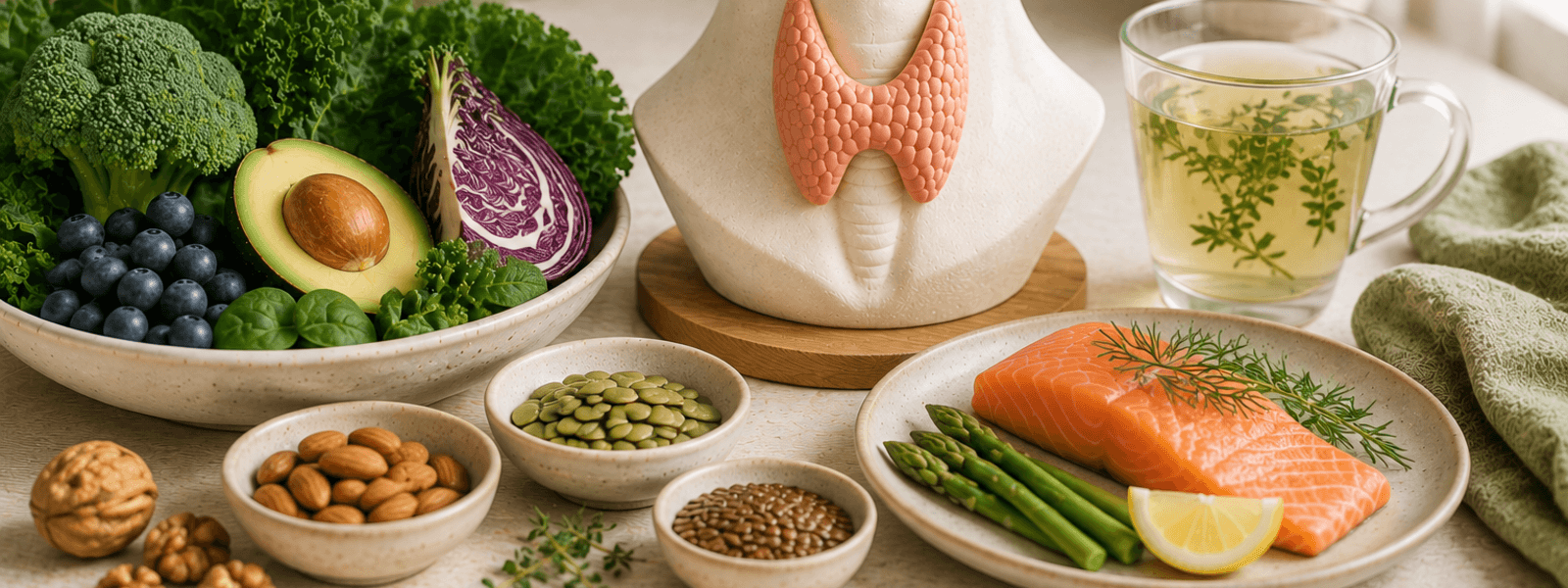
Thyroid Healing Foods
Nourishing Foods for Thyroid Health
Get in Touch With Us!
We aim to get back to you in 24 hours.
What should you actually eat for thyroid health?
It's a simple question with an overwhelming number of answers online.
Brazil nuts. Seaweed. Eggs. Fish. Berries. Gluten-free foods. Dairy-free foods. Supplements. “Superfoods.”
At Thyroid Healing Foods, we help make food and thyroid nutrition easier to understand.
Our approach isn't about finding a miracle ingredient or following an extreme thyroid diet. It's about building varied, nutritious meals from everyday foods and understanding how different nutrients fit into the bigger picture.
Food First. Thyroid Focused.
There is no single food capable of treating or curing a thyroid condition.
What you can do is build an eating pattern that provides a good variety of nutrients and supports your wider health.
The British Thyroid Foundation recommends a balanced diet containing a variety of fruit and vegetables, higher-fibre starchy foods, protein sources and dairy or alternatives.
That's the foundation of our approach.
Instead of asking:
“What's the best thyroid superfood?”
We start asking:
“What does your diet look like across an entire week?”
That shift makes thyroid nutrition much simpler.
Fill Your Plate With Variety
You don't need a separate cupboard of specialist thyroid foods.
For many people, better thyroid nutrition starts with ordinary ingredients.
Protein
Fish, eggs, chicken, lean meat, beans, chickpeas, lentils, dairy and appropriate plant-based alternatives.
Vegetables
Leafy greens, peppers, tomatoes, carrots, broccoli, cauliflower, courgette, mushrooms and plenty of other varieties.
Carbohydrates
Potatoes, oats, rice, pasta, bread and other wholegrain or higher-fibre choices.
Healthy Fats
Olive oil, nuts, seeds, avocado and oily fish.
Fruit
Berries, apples, oranges, bananas, pears, kiwi and whichever other varieties you enjoy.
Rather than eating the same supposedly “perfect” foods every day, variety can help create a much broader nutritional intake.
Discover Foods to Support Your Thyroid Nutrition
What Are Thyroid-Friendly Foods?
The phrase “thyroid-friendly food” is useful, but it shouldn't imply that certain ingredients directly treat thyroid disease.
We use it more simply.
We're talking about nutritious foods that can contribute to a balanced overall diet while living with a thyroid condition.
Depending on your individual requirements, your weekly food choices might include:
- Eggs
- Salmon
- Sardines
- Chicken
- Beans
- Lentils
- Chickpeas
- Greek yoghurt
- Oats
- Potatoes
- Wholegrains
- Leafy vegetables
- Broccoli
- Peppers
- Berries
- Nuts
- Seeds
- Olive oil
You don't need to eat every food on this list.
And none of them is a thyroid treatment.
The goal is to create variety across your diet, rather than obsessing over individual ingredients.
The Nutrients Behind the Food
Why are certain foods constantly mentioned in discussions about thyroid health?
Usually, it's because they contain particular nutrients.
Iodine, selenium, iron and zinc are among those frequently discussed.
Understanding that relationship can be much more useful than simply memorising a list of “good” and “bad” thyroid foods.
Iodine-Rich Foods
Iodine is required for normal thyroid hormone production.
Dietary sources can include foods such as milk, dairy products, eggs and fish.
However, iodine is a perfect example of why more isn't necessarily better.
If you're taking levothyroxine for hypothyroidism, the British Thyroid Foundation says there is no need to take additional iodine supplements. It also advises avoiding kelp products because of their naturally high iodine content.
So instead of automatically reaching for an iodine supplement, we look at your overall diet.
Selenium-Rich Foods
Selenium is another nutrient closely associated with normal thyroid function.
Food sources can include:
- Fish
- Eggs
- Meat
- Beans
- Lentils
- Nuts
Brazil nuts have become particularly famous for their selenium content.
But you don't need to build your entire thyroid diet around Brazil nuts.
They're simply one food among many.
The British Thyroid Foundation notes that although selenium is involved in thyroid hormone metabolism, evidence doesn't establish selenium supplementation as a treatment for thyroid disease, and excessive supplementation should be avoided.
Foods Containing Iron
Iron can be obtained from foods including meat, beans, lentils, pulses and fortified products.
If you suspect iron deficiency, appropriate medical investigation is preferable to guessing and beginning high-dose supplementation.
This is particularly relevant if you take levothyroxine because iron supplements can interfere with its absorption.
Foods Containing Zinc
Dietary sources of zinc include meat, shellfish, dairy foods, beans, nuts and seeds.
Again, getting a nutrient through food and taking concentrated supplemental doses aren't necessarily equivalent.
We therefore consider what your existing diet provides before automatically adding supplements.
Build a Thyroid-Friendly Breakfast
Rather than prescribing a rigid seven-day meal plan, we can help you understand how meals fit together.
Breakfast might combine:
Protein + fibre-rich carbohydrate + fruit or vegetables + healthy fats
Depending on your preferences, that could translate into:
Eggs + wholegrain toast + vegetables
Yoghurt + oats + berries + seeds
Oats + yoghurt + fruit + nuts
Eggs + avocado + wholegrain toast
Your choices can then be adapted around your dietary requirements and, where relevant, thyroid medication.
Build a Balanced Lunch
Lunch doesn't need to be complicated either.
Start with a protein source.
Add vegetables.
Include an appropriate carbohydrate.
Then consider healthy fats.
For example:
Chicken + salad + wholegrain wrap
Tuna + potato + mixed salad
Lentils + vegetables + rice
Egg + salad + wholegrain bread
Chickpeas + grains + roasted vegetables
The objective isn't to create a medically special “thyroid lunch”.
It's to make a balanced lunch easy to repeat.
Build a Better Dinner
The same principle works for your evening meal.
Think:
Protein → vegetables → carbohydrate → healthy fats
That could become:
Salmon + potatoes + green vegetables
Chicken + rice + roasted vegetables
Lentil curry + rice + spinach
Lean meat + potatoes + mixed vegetables
Bean chilli + rice + salad
Once you understand the framework, hundreds of different meals become possible.
That's much more flexible than following a restrictive meal plan.
Build a Better Thyroid-Friendly Diet
Your Thyroid-Friendly Shopping Basket
Healthy eating becomes easier when the right ingredients are already in your kitchen.
Instead of buying expensive products marketed specifically for thyroid health, build your weekly shop around several basic categories.
Protein
Choose several sources you genuinely enjoy.
Vegetables
Pick different colours and varieties.
Fruit
Choose options you'll realistically eat.
Higher-fibre carbohydrates
Stock foods that work with your normal meals.
Healthy fats
Keep simple options such as nuts, seeds and olive oil available.
Dairy or alternatives
Choose appropriate options based on your diet.
You can then combine the same core ingredients in different ways throughout the week.
Stop Searching for the Perfect Thyroid Superfood
The idea of a “superfood” is appealing because it makes nutrition sound simple.
Eat this one ingredient and improve your health.
Real nutrition doesn't work quite like that.
A Brazil nut isn't going to compensate for an otherwise poor diet.
Neither will eating berries every morning.
And adding seaweed to everything because it contains iodine isn't necessarily sensible for somebody with thyroid disease.
The quality of your whole diet matters much more than chasing individual ingredients.
Foods You Don't Automatically Need to Avoid
Just as certain foods are labelled “thyroid superfoods”, others are often presented as foods everybody with thyroid disease should avoid.
These lists can become extremely restrictive.
You might see:
Gluten
Dairy
Soya
Broccoli
Cabbage
Cauliflower
Carbohydrates
But having a thyroid condition doesn't automatically mean all these foods need to disappear.
Can You Eat Broccoli?
Broccoli, cauliflower, cabbage and kale are brassica vegetables.
They sometimes appear on thyroid “avoid” lists because very high intakes can potentially contribute to goitre formation.
However, the British Thyroid Foundation says consumption would need to be very high before this became a realistic concern and that under normal UK dietary conditions the risk is very low.
For most people, that means there is no reason to become frightened of eating broccoli as part of a varied diet.
Do You Need to Avoid Gluten?
Not everyone with thyroid disease needs to stop eating gluten.
There are individual situations where gluten must be avoided — most importantly diagnosed coeliac disease.
But that is different from saying gluten is universally unsuitable for people with thyroid conditions.
If you've already removed gluten, we can look at what you've replaced those foods with and whether your remaining diet provides sufficient variety.
What About Dairy?
The same principle applies to dairy.
You don't automatically need to remove milk, yoghurt and cheese because you have a thyroid condition.
If dairy doesn't form part of your diet, we can consider suitable alternatives.
The important question is always:
If we remove something, what are we replacing it with?
Hashimoto's and Food
People with Hashimoto's often encounter particularly restrictive food advice.
Gluten-free.
Dairy-free.
Grain-free.
Soya-free.
Sugar-free.
Autoimmune protocols.
Rather than immediately eliminating numerous foods, we start with your existing diet.
We can look at what you're eating, what you've already removed and whether your diet still contains enough variety.
There isn't one specific “thyroid diet” recommended for everybody with a thyroid condition.
That means your food choices should be considered individually rather than dictated by a generic Hashimoto's food list.
Food for an Underactive Thyroid
If you have hypothyroidism, food plays a different role from medication.
Levothyroxine replaces thyroid hormone that your body isn't producing sufficiently; food does not. Current NHS guidance describes levothyroxine as a medicine used to treat an underactive thyroid.
Our role is therefore complementary.
We can help you improve your nutritional intake while your thyroid condition continues to be appropriately medically managed.
Food and Levothyroxine
If you take levothyroxine, when you eat can sometimes matter as much as what you eat.
Current NHS guidance recommends taking levothyroxine on an empty stomach, generally 30–60 minutes before your first meal, caffeinated drink or other medicine of the day.
Certain foods, supplements and medicines can also interfere with absorption.
Calcium and iron supplements are among those highlighted by the NHS, while the British Thyroid Foundation also identifies soya as an interaction.
This doesn't mean your diet needs to become unnecessarily restrictive.
Sometimes the solution is about timing, not permanently eliminating a nutritious food.
Always follow your medication instructions and speak to your doctor or pharmacist about medication-specific questions.
Thyroid Supplements vs Real Food
There's a huge market for supplements claiming to support the thyroid.
You may encounter products containing:
- Iodine
- Selenium
- Zinc
- Iron
- Vitamin D
- Vitamin B12
- Biotin
- Magnesium
- Herbal extracts
Supplements can have a role in particular circumstances, but they shouldn't automatically become the foundation of your thyroid diet.
The British Thyroid Foundation recommends avoiding excessive supplement doses and states that supplements should never be taken as an alternative to prescribed medication.
Our philosophy is:
Understand your diet first. Supplement appropriately second.
More Foods In, Not Just Foods Out
One thing that makes Thyroid Healing Foods different is our focus on adding variety.
Instead of constantly asking what you need to eliminate, we might ask:
Could you eat another type of vegetable this week?
Could beans or lentils feature more regularly?
Could breakfast contain more protein?
Could you swap one refined carbohydrate for a higher-fibre alternative?
Could you introduce another type of fish?
Could your lunches contain more vegetables?
Could you vary your protein sources?
These are small changes.
But collectively, they can transform the quality and variety of your diet without creating an exhausting list of restrictions.
Vegetarian Thyroid Foods
A vegetarian diet can contain a huge variety of nutritious foods.
Depending on your preferences, meals can incorporate:
- Eggs
- Yoghurt
- Beans
- Lentils
- Chickpeas
- Tofu
- Nuts
- Seeds
- Wholegrains
- Vegetables
- Fruit
Particular attention can then be given to nutrients such as protein, iron, vitamin B12, iodine, selenium and zinc depending on what you actually consume.
Vegan Thyroid Foods
A vegan diet can also contain plenty of nutritious whole foods.
However, because all animal-derived foods are excluded, certain nutrients deserve more deliberate consideration.
Rather than creating a universal vegan thyroid diet, we look at your individual intake, including the fortified foods and supplements you already use.
This helps ensure your nutritional approach reflects what you're genuinely eating.
Make Food Work Around Your Life
The healthiest meal plan in the world isn't useful if you can't maintain it.
That's why practicality matters.
You may need breakfast in five minutes.
Lunch might need to travel to work.
Dinner may need to feed four people.
You might dislike cooking.
Or perhaps you want meals you can prepare in bulk on Sunday and eat throughout the week.
Your nutrition plan can take all of this into account.
Instead of designing your life around your diet, we help design your diet around your life.
Personalised Thyroid Food Support
There's no reason two people with the same thyroid diagnosis should automatically eat identical diets.
One person may be vegetarian.
Another may want to manage their weight.
Someone else might have eliminated half their normal foods after reading thyroid advice online.
And another person may simply want to know whether their everyday meals are balanced.
We can look at your:
Current foods → meal structure → dietary variety → restrictions → supplements → routine → goals
Then we can identify the areas most worth improving.
Why Choose Thyroid Healing Foods?
Food-Focused
Our approach starts with what you actually eat.
No Miracle Foods
We don't claim that individual ingredients can cure or treat thyroid disease.
More Variety
We look at foods you could beneficially introduce rather than focusing entirely on elimination.
Practical Meals
Breakfast, lunch and dinner need to work around real life.
Personalised
Recommendations reflect your normal diet and preferences.
Balanced
We consider your overall nutritional intake rather than obsessing over one nutrient.
Online Thyroid Food & Nutrition Support
Our online consultations make personalised thyroid nutrition support available throughout the UK.
You can discuss your current diet, meals, food restrictions, supplements and nutritional goals from home.
Your initial consultation gives us an opportunity to understand what you're currently eating.
From there, we can identify practical improvements.
That could mean increasing dietary variety, improving meal composition, understanding particular nutrients, simplifying your shopping or removing unnecessary complexity from the way you eat.
Follow-up consultations can help you put those changes into practice.
Frequently Asked Questions
What are the best foods for thyroid health?
There isn't one “best” thyroid food. A varied diet containing vegetables, fruit, higher-fibre carbohydrates, protein sources and appropriate fats provides a sensible nutritional foundation.
Can food heal your thyroid?
No. Despite the name Thyroid Healing Foods, we don't claim food can heal or cure thyroid disease. The British Thyroid Foundation states that no specific foods or dietary supplements can be used to treat a thyroid disorder.
What foods contain iodine?
UK dietary sources of iodine include foods such as milk, dairy products, eggs and fish. However, additional iodine isn't automatically appropriate for somebody with thyroid disease.
What foods contain selenium?
Selenium can be obtained from foods including fish, eggs, meat, beans, lentils and nuts.
Are Brazil nuts good for thyroid health?
Brazil nuts contain selenium and can form part of a balanced diet, but there is no need to consume excessive quantities in an attempt to treat a thyroid condition.
Should I avoid broccoli?
Not routinely. The British Thyroid Foundation says the risk associated with brassica vegetables is very low under normal UK dietary conditions.
Should I avoid gluten?
Not automatically. A diagnosed condition such as coeliac disease requires a gluten-free diet, but having a thyroid condition alone doesn't mean everyone needs to remove gluten.
Do I need thyroid supplements?
Not necessarily. Your existing diet, individual circumstances and medical requirements should be considered rather than automatically starting a collection of thyroid supplements.
Can you help me create a thyroid-friendly meal plan?
Yes. We can help you develop practical meal ideas around your food preferences, dietary requirements, routine and nutritional goals.
Put Better Food on Your Plate
Thyroid nutrition doesn't have to revolve around restrictions.
And you don't need to spend your time searching for the latest thyroid superfood.
At Thyroid Healing Foods, we focus on something much more practical:
Eat a greater variety. Build balanced meals. Understand your nutrients. Make food work around your life.
We'll help you look at what you're currently eating and identify realistic ways to improve it.
Get in touch today to start building your personalised approach to thyroid nutrition.
What People are Saying About Us
★★★★★
“I’d been so focused on finding the perfect foods for my thyroid that eating had become complicated. The guidance helped me get back to simple, balanced meals using foods I actually enjoy.”
Amanda Lewis
North West
★★★★★
“The biggest change has been the variety in my diet. I’ve discovered lots of easy ways to include more protein, vegetables and nutritious ingredients without completely changing how I eat.”
Samantha Reed
North West
★★★★★
“I loved the food-first approach. Instead of being given another list of supplements, I learned how to build balanced breakfasts, lunches and dinners from normal everyday ingredients.”
Chloe Martin
North West
★★★★★
“I had a long list of foods I thought I needed to avoid. The support helped me simplify everything and create meals that are varied, practical and much easier to stick with.”
Karen Whitfield
North West
Start Improving Your Everyday Food Choices